Repent, Resolve January 2025

"the tyme is fulfylled, and the kyngdome of God is at hande: Amende youre selues, and beleue the gospell." — Mark 1:15, The Coverdale Bible, 1535
Good morning, and happy new year. For a few days now I've been thinking on the two words featured in the title of this newsletter. The prefix 're', as you likely know, means again, or back: to return, or do something you've done before. So both words connected through that idea, but each having its own array of meanings that somehow give me pause for thought and reflection—reflection, another re word, this one meaning to throw back light, to illuminate.
I think if I could have my life over again I'd study etymology. It seems to me to be the root of understanding and maybe even enlightenment; lacking the academic prowess however, I muddle through with the help of a search engine to untangle the meaning of the language I use, seeking a rare moment of clarity.
Repent: The Greek word μετάνοια (metanoia) means a transformative change of heart and mind, a lifting, a turning around, an opening of oneself to new possibilities. It is a beautiful word, both in sound and in meaning, and is actually one of the first words out of the mouth of Jesus, in the earliest gospel. Sadly this elegant, uplifting word got translated by the early church in Rome to paenitentiam agite, a term meaning suffer (pain) or 'do penance'. Here we see a hint of what Rome would do to Christianity, i.e. use it as a tool to oppress and control the hoi poloi. From this, the English translators 1 gave us the word 'repent' which, stemming from the Latin word rēpent which means 'to crawl', is essentially an instruction to grovel, be ashamed, feel guilt, all a far cry from the idea of being lifted up, out of the bondage of self.
The word, metanoia, comes from two Greek words: Meta, meaning above or beyond; and Nous, meaning mind. "Metanoia invites us to move above our normal instincts, into a bigger mind, into a mind which rises above the proclivity for self-interest and self-protection which so frequently trigger feelings of bitterness, negativity, and lack of empathy inside us." 2 The theologian, Henri Nouwen, contrasted the term metanoia with another common word of the time, paranoia, which literally means to be beside oneself, and was the Greek word for madness; it is characterised by irrational fear, self-protection, suspicion and mistrust. Metanoia is a foil against all of this, helping us rise above our base instincts, opening up our heart, moving from self-interest to other-interest, and widening our perspective. Paranoia closes us down into self; Metanoia lifts us up to God. With his first recorded words, Jesus was offering his listeners a change of mind and heart, a new way to live, "a reordering and reorganizing of one's whole life".3 He was not peddling a guilt trip!
The fact is though, that after several hundred years, we are left with the word repent, and all its associated baggage. It is rather too late to change it back to its original meaning, and, in truth, the word likely still serves the organised church with its creed of original sin, and a residual need for hierarchical authority. Knowing the root of a word though allows us to do an internal translation, which in this case means casting off the shackles of top-down control, opening the cage, and freeing the word to once again fly.
Resolve: This word has its root in the Latin resolvō, meaning to loosen, thaw or melt. Interestingly it is used to mean both the end of something, for example, come to a resolution, and the start of something new, for example, make a New Year's resolution. At this time of the year, naturally, the latter meaning is at the forefront. But what if our New Year resolution meant not some big, up-front commitment, always so hard to maintain, but a simple daily commitment to embrace the thaw, to resolve. To accept failure is to reach resolution, freeing us up for a new attempt: try again, try differently.
The average day of the year we give up on our resolutions is the second Friday in January, which has come to be known as Quitters Day. Quitters Day this year falls on 10th January. You might like to put a note in your calendar, and a reminder that your anticipated small failure is a learning moment, and a step towards greater change. Try again, re-solve.
Word of the Year: I rarely make New Year resolutions, but instead have taken up the practice of finding a single word each year to live by.4 This year, the word that offers itself for 2025 is, naturally enough, Metanoia. Embracing metanoia will allow me to engage in the ongoing process of reordering and reorganising my life along spiritual principles—and paying attention along the way. God knows I need it :)
1 With the exception of Myles Coverdale (quoted above) who, in one of the first full translations of the Bible into English, offered the phrase, Amend yourselves, a little closer in spirit to metanoia, but rather lacking its poetry.
2 From Paranoia to Metanoia, Ron Rolheiser, 12/09/2016
3 Metanoia in a World of Paranoia, Spencer Loman, 12/03/2024
Additional sources:
Metanoia: the First Words Out of Jesus' Mouth, Pastor Dawn Hutchings, 18/07/2021;
Spiritual Life: Meaning of repent altered in translation, Suzette Martinez Standring, 10/04/2011.
4 This is my seventh year of setting a word-of-the-year. Previous ones were Friendship (2024), Possibility (2023), Awake (2022), Moment (2021), Less (2020), and Big (2019). I extend gratitude to my friend Surya for seeding the idea.
—
December News
These are the exact words I wrote on 1st January 2024:
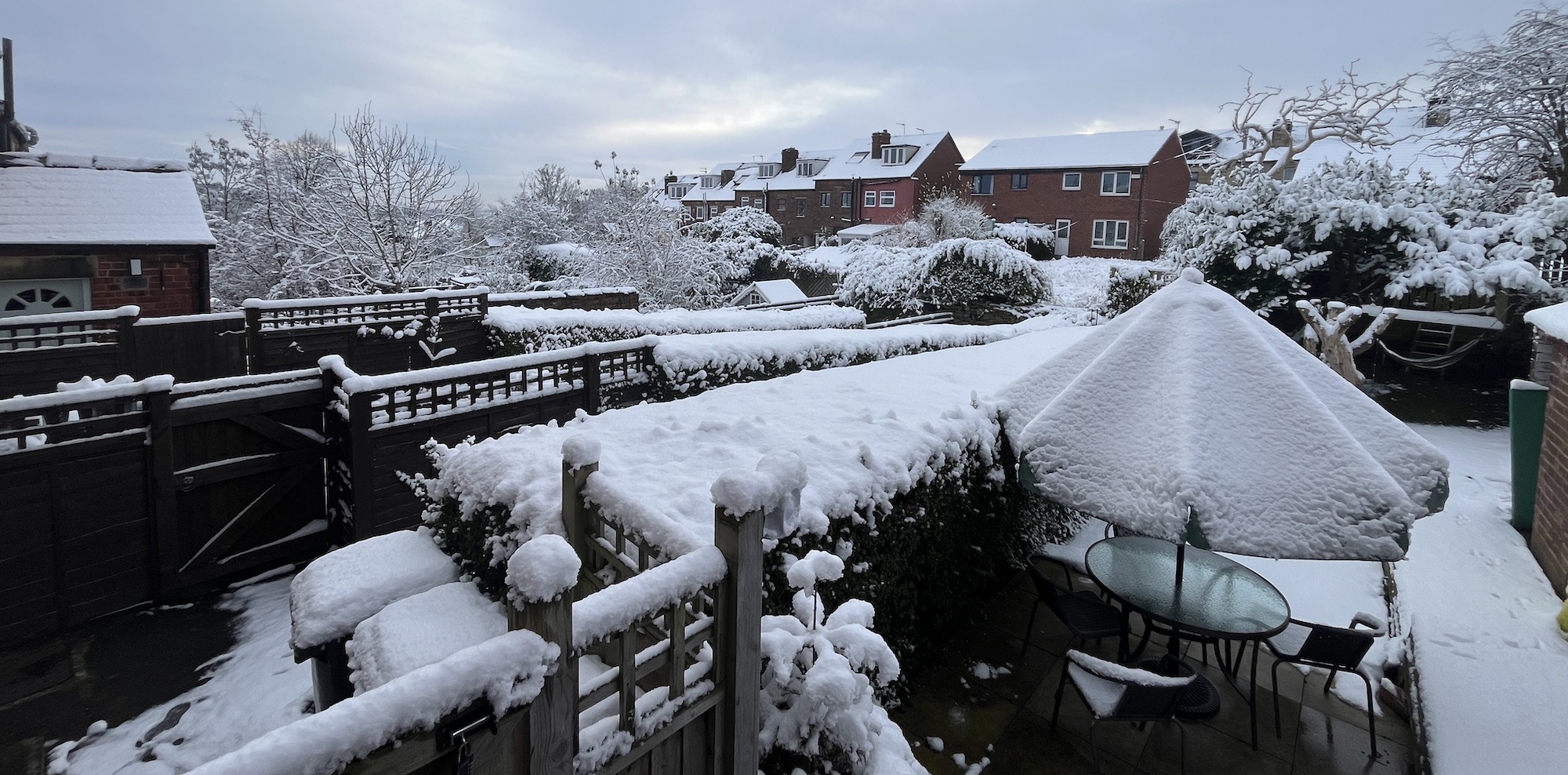
We had snow in the first few days of December, but only rain since then. We dreamed of a white Christmas, but received a wet one. It was also windy, with Sheffield trees blowing down and roofs blowing off. We enjoyed our few days of snow though, and hope for more as winter sets in deeper in January.
This year was almost identical, except the snow came in mid-November, never to return. Maybe next year, snow in October :)
December was the usual build up to Christmas. As a family we committed to watching a Christmas film every day for the first 24 days of December—but with the frequent, and it must be said quite wonderful Steel City Choristers performances throughout the month this led to many late nights and subsequent tiredness and grumpiness all round. Breaking from school was a welcome relief and sleeping in until 11 or 12 o'clock is now the pattern for my wife and daughters. In addition to the choir, Asrai (age 11) was invited to sing the solo opening verse of Once in Royal David's City at midnight mass on Christmas Eve, a very special service, and a lovely way to welcome in the day.
Rayna'a parents arrived from Los Angeles on the 30th, and are staying in Sheffield until the 5th, so lots of socialising and more late nights. We saw in the new year together, staying up until 2.30 am singing karaoke, and then celebrating my new year's day birthday. Yes, I reached sixty-six: officially retirement age, but actual retirement is a long way away for me. I count my blessings.
So here we are again, another January, another year.
"January...a two-faced month, jangling like jester's bells, crackling like snow crust, pure as any beginning, grim as an old man, mysteriously familiar yet unknown, like a word one can almost but not quite define." — Patricia Highsmith, The Price of Salt
Embrace the mystery then, and I'll see you in another month,
Tobias
If you'd like to receive my monthly newsletter by email click here to subscribe.
Recent Writing
- Not Agile? Good!
- The Futility of Change
- Register with the Agile Network to read more of my upcoming articles in the 2025 Prophetic Leadership series.
Upcoming events — Full List Here
- Roots & Ancestry, 7th January, 3-6 pm GMT, online
- Certified Scrum Master, 13-15 January & 4-6 February, online
- The Collaborative Scrum Team, 11-12 February, online, 3 hours each day
- Navigating Conflict, 4-5 March, online, 6 hours each day
- Feast of Facilitators, 20-22 March, online 4 hours each day
Limited places, selling fast. Book soon!
There are also many free Agile Conversations online meetups planned, including
- #TrueScrumMaster, rescuing scrum masters from the corporate quagmire
- scripture@work, reading the Bible as a corporate change manual, co-created and hosted with Daniel Susser
For those in leadership positions or working as executive/c-level coaches, you may also be interested in the three options to become a Certified C-Suite Agile Leader offered in partnership with Allisyn James and Ambidextrous UK.
As always you can find full details of all workshops and events on my website, both open/public and bespoke/private. Reach out for more information if you need to.
2nd January 2025, 8.00 am Reply to this newsletter